A shopping center parking lot is often the first part of a commercial property that customers experience. Therefore, a smooth, well-maintained parking area can create a positive first impression, improve vehicle circulation, and make shopping more convenient. However, cracked asphalt, potholes, faded pavement markings, and uneven surfaces can quickly make a property look neglected. For shopping center owners and property managers, investing in shopping center parking lot paving in Fremont, CA is an important step toward maintaining an attractive, functional, and welcoming commercial environment.
Jobco Paving can help property owners explore paving solutions that support the needs of busy commercial spaces. Whether you are planning a new parking lot, upgrading an aging asphalt surface, or addressing pavement deterioration, choosing the right paving approach is essential. Furthermore, professional planning can help reduce unnecessary disruptions, manage maintenance expenses, and improve the long-term performance of your parking area.
Fremont’s commercial properties must accommodate different types of traffic, from daily customer vehicles to delivery trucks and service vehicles. Consequently, parking lot paving requires more than simply laying asphalt. Instead, the project should account for drainage, pavement strength, pedestrian access, traffic flow, surface preparation, and ongoing maintenance.
In this guide, we explain the benefits of professional shopping center parking lot paving, important planning considerations, common pavement problems, and practical ways to protect your investment.
Why Shopping Center Parking Lot Paving Matters in Fremont, CA
Shopping centers depend on convenient access and a positive customer experience. Therefore, the condition of the parking lot can influence how customers perceive the entire property.
First, a smooth surface makes it easier for customers to enter, park, and move around the shopping center. Additionally, clearly organized parking spaces can help drivers navigate the property more efficiently. As a result, a properly planned parking lot can support a more comfortable shopping experience.
Second, pavement condition affects the appearance of the property. For example, widespread cracks, potholes, and faded surfaces may make even a well-maintained retail building appear older. Conversely, a professionally paved parking lot can create a cleaner, more organized appearance.
Moreover, parking lots must withstand regular vehicle movements and changing weather conditions. Therefore, selecting suitable materials and preparing the underlying base correctly are essential for durability.
For shopping center owners in Fremont, investing in professional paving is not simply about appearance. Rather, it is about maintaining a functional property that supports customers, tenants, employees, and delivery operations.

What Makes Shopping Center Parking Lot Paving Different?
Unlike a small residential driveway, a shopping center parking lot serves a wide range of users throughout the day. Consequently, its design and construction require careful consideration of traffic volume, vehicle weight, drainage, pedestrian movement, and access points.
For example, the main entrance may experience frequent turning and braking, while delivery zones may carry heavier loads. Meanwhile, pedestrian routes need to connect parking spaces with storefronts in a clear and accessible way.
Therefore, an effective commercial paving plan should consider several essential elements:
- Traffic capacity: The pavement must suit the expected number and types of vehicles.
- Base preparation: The underlying foundation must provide appropriate support for the finished surface.
- Drainage design: Water should flow toward suitable drainage areas rather than collect in low spots.
- Parking layout: Spaces, drive aisles, and turning areas should support efficient circulation.
- Pedestrian access: Walkways and crossings should be planned with customer movement and accessibility in mind.
- Maintenance requirements: The selected paving system should support a practical long-term maintenance plan.
Furthermore, property managers should consider future needs, including changes in tenant occupancy, delivery schedules, traffic patterns, and parking demand. By planning these details early, they can make better decisions about the project’s scope and budget.
Benefits of Professional Shopping Center Parking Lot Paving
Professional paving can offer several advantages when the project is designed around the property’s actual needs.
Improved Curb Appeal
A fresh, consistent pavement surface can make a shopping center look cleaner and more inviting. Additionally, well-defined parking spaces and organized traffic routes can improve the overall appearance of the property.
Consequently, the parking area can complement the storefronts, landscaping, and other exterior features rather than detract from them.
A Smoother Driving Surface
Potholes, uneven patches, and deteriorating asphalt can make parking less comfortable. Therefore, addressing these issues can help create a smoother surface for customers and employees.
However, the correct solution depends on the cause of the damage. While some defects may require localized repairs, widespread surface deterioration or structural failure may require resurfacing or reconstruction.
Better Traffic Organization
A shopping center needs an efficient layout that helps customers locate parking spaces and navigate between different areas. Accordingly, paving work should coordinate with parking layouts, directional markings, pedestrian crossings, and access routes.
Furthermore, clear pavement markings can help drivers understand where to park and where to travel. Nevertheless, markings and accessibility features should comply with applicable requirements.
Support for Long-Term Property Maintenance
Although paving requires an initial investment, a properly designed surface and consistent maintenance can help property managers manage deterioration more effectively.
For example, promptly addressing cracks and drainage concerns may reduce the likelihood of more extensive damage. In addition, periodic inspections can help identify problems before they interfere with daily operations.
Asphalt or Concrete: Which Paving Material Is Better?
When planning shopping center parking lot paving in Fremont, CA, property owners should evaluate whether asphalt, concrete, or a combination of materials best suits their needs.
Asphalt is commonly considered for parking areas because it provides a continuous driving surface and can be practical for projects that require future surface maintenance. Concrete, meanwhile, may be suitable for specific areas that experience particular loading or operational demands.
However, the right material depends on traffic, soil conditions, drainage, installation requirements, budget, and expected maintenance.
| Comparison factor | Asphalt paving | Concrete paving |
| Appearance | Smooth, dark surface | Typically lighter, rigid surface |
| Construction considerations | Requires proper base preparation and compaction | Requires suitable subgrade preparation, placement, and curing |
| Maintenance | May require crack repairs, sealcoating, and resurfacing | May require joint maintenance and repairs to damaged sections |
| Project suitability | Often considered for general parking areas and drive aisles | May suit selected heavy-use areas or specific design requirements |
| Long-term performance | Depends on pavement design, traffic, drainage, and maintenance | Depends on concrete design, loading, joints, curing, and maintenance |
Neither material is automatically the best choice for every shopping center. Instead, property owners should compare the initial installation costs with expected maintenance, operating requirements, and the conditions at the site.
For projects where concrete may be appropriate, explore commercial concrete paving solutions from Jobco Paving.
The Shopping Center Parking Lot Paving Process
A successful paving project begins with careful planning. Although the exact process varies according to the condition of the site, several stages commonly contribute to a reliable result.
Step 1: Inspect the Existing Parking Lot
First, the contractor should evaluate the current pavement and identify visible defects. These may include cracking, potholes, rutting, uneven areas, drainage problems, and deterioration around entrances.
Additionally, the inspection should consider how the parking lot is used. For instance, delivery lanes and frequently traveled entrances may require different treatment from lightly used parking spaces.
As a result, the inspection helps establish whether the property needs localized repairs, resurfacing, or more extensive reconstruction.
Step 2: Develop a Paving Plan
Next, the contractor should establish the project’s scope. This plan may include the work area, pavement specifications, drainage improvements, access arrangements, and expected construction schedule.
Furthermore, shopping center management should identify busy trading periods, scheduled deliveries, and tenant requirements. By coordinating these details in advance, the team can develop a plan that reduces avoidable disruption.
Step 3: Prepare the Site
Proper preparation is essential because the finished pavement depends on the condition of the material beneath it.
Depending on the project, preparation may involve removing damaged asphalt, repairing weak areas, correcting grading issues, and preparing the base. However, the required work should reflect the actual site conditions rather than follow a one-size-fits-all approach.
Step 4: Install the Paving Material
Once the site is ready, the selected paving material can be installed according to the project’s specifications. For asphalt, proper placement, layer thickness, and compaction are important considerations.
Moreover, transitions around entrances, drainage structures, curbs, and adjoining surfaces should be addressed carefully. Otherwise, poorly managed transitions may create uneven areas or allow water to accumulate.
Step 5: Complete Markings and Final Checks
After paving and any required waiting period, the project may proceed to pavement markings and other finishing details.
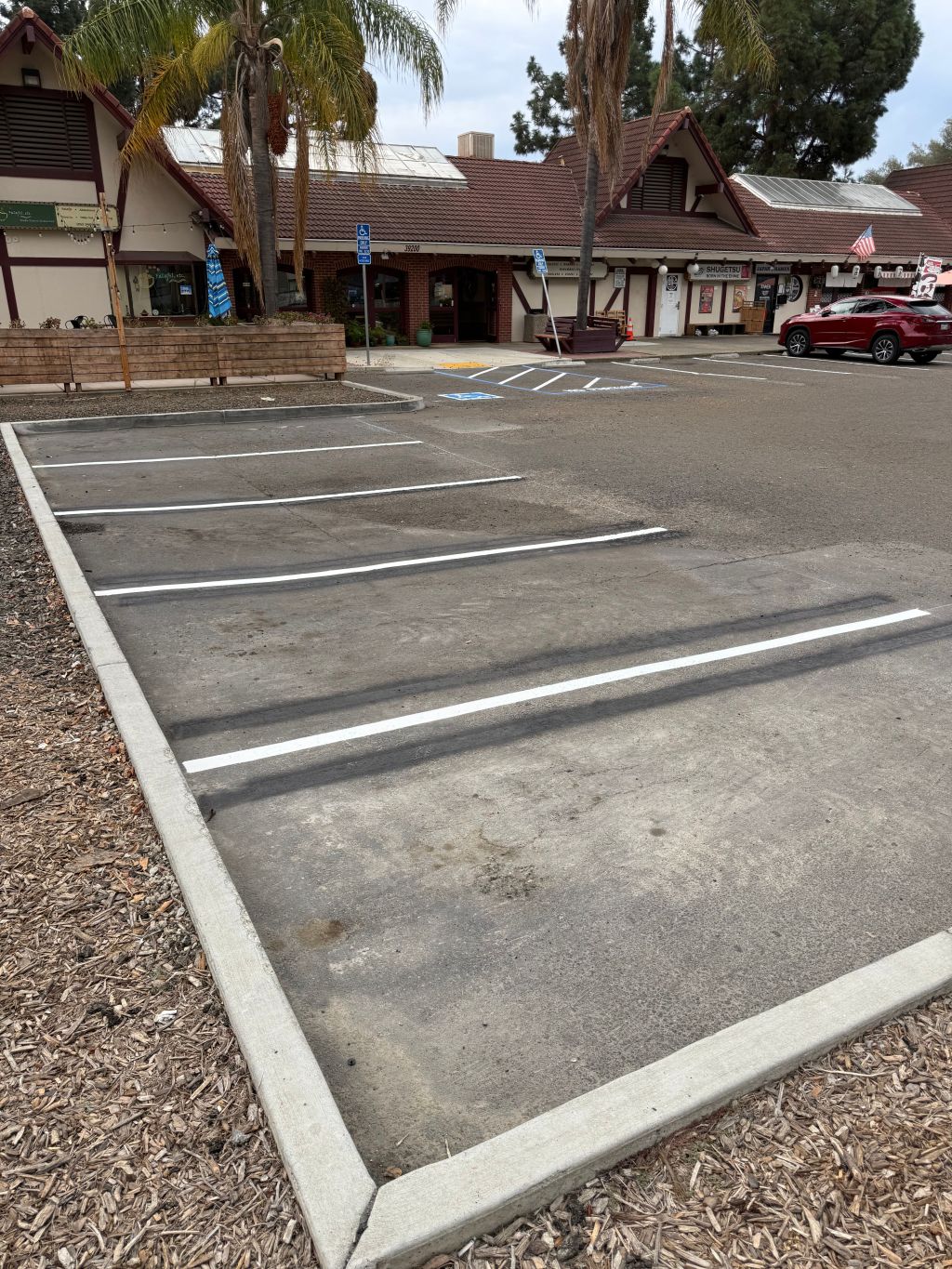
These may include parking-space lines, directional arrows, pedestrian crossings, and designated accessible parking features. Additionally, the completed surface should be checked for visible defects and drainage concerns.
Finally, property management should confirm the reopening schedule and communicate any remaining restrictions to tenants and customers.
Common Parking Lot Problems and How to Address Them
Commercial parking lots are exposed to repeated traffic, moisture, temperature changes, and everyday wear. Consequently, different types of pavement damage may develop over time.
| Parking lot problem | Possible cause | Recommended next step |
| Small cracks | Aging, weather exposure, or surface movement | Inspect and repair using a suitable crack-treatment method |
| Potholes | Water intrusion, traffic stress, or pavement failure | Assess the damage and repair the affected pavement properly |
| Standing water | Poor drainage, settlement, or grading problems | Identify and correct the underlying drainage or elevation issue |
| Wheel-path rutting | Repeated loading, inadequate support, or material deformation | Evaluate the pavement structure and determine the appropriate repair |
| Faded surface | Weather exposure and aging | Assess whether maintenance, sealcoating, or resurfacing is suitable |
| Worn parking lines | Traffic and weather exposure | Refresh markings when the surface and conditions allow |
Importantly, visible damage does not always reveal the full extent of the problem. For example, a pothole may indicate that water has weakened the underlying base. Therefore, simply filling the hole without addressing the cause may result in recurring damage.
Similarly, resurfacing may improve a worn surface, but it cannot reliably correct a failing foundation by itself. As a result, a proper assessment should guide the repair strategy.
How to Maintain a Shopping Center Parking Lot After Paving
After completing a paving project, property managers should establish a maintenance plan. Although the exact schedule depends on traffic, weather, pavement type, and site conditions, regular inspections can help protect the investment.
Schedule Routine Inspections
First, inspect the parking lot periodically for cracks, potholes, depressions, loose material, and drainage changes. In addition, pay attention to high-traffic areas, delivery zones, entrances, and places where vehicles turn frequently.
Consequently, maintenance teams can identify developing issues before they become more disruptive.
Address Water and Drainage Problems
Water can contribute to pavement deterioration when it enters cracks or remains in low areas. Therefore, keep drainage structures clear and investigate recurring puddles.
Furthermore, correct drainage problems before carrying out surface treatments that would not address the underlying cause.
Consider Appropriate Sealcoating
For suitable asphalt surfaces, sealcoating may help protect the pavement against weather exposure and certain surface contaminants. However, it is a maintenance treatment rather than a structural repair.
Accordingly, the surface should be evaluated first to determine whether sealcoating is appropriate and whether repairs are needed beforehand.
Shopping center managers can learn more about asphalt sealcoating and driveway surface protection and discuss how the relevant maintenance options may apply to their property.
Keep the Surface Clean
Remove accumulated debris, leaves, and other materials that may obstruct drainage or conceal developing defects. Additionally, maintain clear access to drains and inspection points.
However, cleaning alone will not resolve structural damage. Therefore, combine routine housekeeping with appropriate pavement inspections and repairs.
Follow Professional Maintenance Recommendations
Finally, use a maintenance schedule based on the pavement’s condition and expected traffic. For further information, review pavement maintenance and surface protection services.
By combining regular inspections with timely repairs, property managers can make more informed decisions about when maintenance is sufficient and when more substantial paving work is necessary.
How to Minimize Disruption During Parking Lot Paving
Shopping centers often remain open during renovation work. Therefore, scheduling and communication are particularly important.
First, divide the project into manageable phases when site conditions and the construction plan permit. This approach may allow portions of the parking lot to remain accessible while other areas are being improved.
Next, coordinate with tenants, delivery providers, and property management. For example, schedule work around major deliveries or particularly busy periods whenever practical.
Additionally, provide clear temporary signs and direct customers toward available parking areas. Where appropriate, establish safe pedestrian routes and ensure that construction zones are clearly separated from public access.
Finally, communicate expected closures and reopening times. Although unexpected delays can occur because of weather or site conditions, timely updates help tenants and customers plan ahead.
Nevertheless, the phasing strategy must remain safe and practical. Some projects may require larger closures to allow proper construction and protect workers and visitors.
Decorative Paving and Hardscape Options for Shopping Centers
A shopping center’s exterior includes more than its main parking area. In addition to vehicle surfaces, walkways, entrance areas, pedestrian plazas, and landscaped spaces can influence how visitors experience the property.
For example, paving stones may help create defined pedestrian areas or decorative features. Meanwhile, concrete hardscapes can complement outdoor gathering spaces and selected access routes.
However, decorative surfaces should be selected according to their intended use, accessibility, drainage requirements, maintenance needs, and compatibility with adjacent pavement.
Property managers exploring these improvements can review commercial masonry paving stones for potential hardscape applications. Additionally, paving stone hardscape options may help inform design decisions for suitable outdoor areas.
For other exterior improvements, concrete hardscape solutions may also be relevant.
Furthermore, while residential driveway paving is designed around different property needs, Jobco Paving’s residential asphalt driveway paving services provide another example of how pavement requirements can vary according to the property’s purpose.
Ultimately, the best design balances appearance with function. Therefore, decorative features should enhance the shopping center without compromising vehicle circulation, pedestrian access, or maintenance practicality.
How Much Does Shopping Center Parking Lot Paving Cost in Fremont, CA?
The cost of shopping center parking lot paving depends on several project-specific factors. Consequently, property managers should request an estimate based on the actual site rather than rely on a general price alone.
Important cost factors include:
- Total pavement area: Larger parking lots require more materials and labor.
- Existing pavement condition: Extensive cracking, potholes, or structural damage may require additional repairs.
- Material selection: Asphalt and concrete have different installation requirements and cost considerations.
- Base preparation: Weak or unstable areas may require additional excavation or reconstruction.
- Drainage requirements: Correcting water flow or grading problems can affect the project scope.
- Traffic management: Maintaining access during construction may require phased work and additional coordination.
- Markings and finishing: Parking lines, directional arrows, accessible spaces, and related details contribute to the final scope.
- Scheduling and site access: Delivery restrictions, work-hour limitations, and equipment access can influence the construction plan.
Moreover, the lowest initial estimate may not provide the best value if it excludes essential preparation or repairs. Therefore, compare written estimates carefully and confirm what each proposal includes.
A detailed estimate should explain the proposed work, material specifications, preparation requirements, anticipated schedule, and any exclusions or allowances.
Why Consider Jobco Paving for Your Commercial Paving Project?
Choosing a paving contractor is an important decision for any shopping center owner or property manager. Although cost is an essential consideration, the quality of the assessment, preparation, material selection, and project coordination also matters.
Jobco Paving is a resource for property owners exploring paving and surface maintenance options. Before moving forward, discuss the condition of your existing parking lot, the demands placed on the pavement, and the improvements needed to support your property’s operations.
Additionally, ask for a clear explanation of the recommended work. A reliable project plan should identify whether the parking lot needs repairs, resurfacing, replacement, or a combination of solutions.
Consider asking the following questions before approving the project:
- What is causing the current pavement damage?
- Is resurfacing appropriate, or is reconstruction necessary?
- Will drainage or base repairs be required?
- Which paving materials are suitable for the property’s traffic?
- How will construction affect customers, tenants, and deliveries?
- What is included in the written estimate?
- What maintenance is recommended after completion?
By discussing these questions in advance, you can better understand the project and compare options based on value rather than price alone.
Frequently Asked Questions About Shopping Center Parking Lot Paving in Fremont, CA
How often should a shopping center parking lot be repaved?
There is no universal repaving schedule. Instead, the timing depends on pavement condition, traffic volume, material quality, drainage, installation, and maintenance history. Therefore, periodic professional inspections can help determine when repairs, resurfacing, or replacement are necessary.
Is asphalt a good choice for shopping center parking lots?
Asphalt can be a practical option for many shopping center parking areas because it provides a continuous driving surface and allows several forms of maintenance. However, suitability depends on expected traffic, soil conditions, drainage, loading requirements, and the project’s specifications.
Can an existing shopping center parking lot be resurfaced?
Yes, if the existing pavement is suitable for an overlay. However, the contractor should assess cracks, rutting, potholes, drainage, and base stability first. If substantial structural damage exists, more extensive repairs or replacement may be necessary.

How can parking lot paving affect shopping center operations?
Construction may temporarily limit parking spaces, entrances, or drive aisles. Nevertheless, careful scheduling, phased work where feasible, clear signage, and communication with tenants can help reduce disruption.
Does parking lot paving include line striping?
It can, depending on the project scope. Parking lines, directional markings, pedestrian crossings, and accessible parking features should be identified in the estimate so that the completed project meets the property’s operational needs and applicable requirements.
Why is drainage important for commercial parking lots?
Effective drainage helps prevent standing water and reduces the risk of moisture-related pavement damage. Therefore, grading and drainage should be assessed during paving planning rather than treated as an afterthought.
Is sealcoating enough to repair a damaged parking lot?
No. Sealcoating may help protect suitable asphalt, but it does not correct major potholes, structural failures, or serious drainage problems. Consequently, the pavement should be inspected to determine whether repairs or resurfacing are needed first.
How can property managers estimate paving costs?
Start by identifying the approximate pavement area, visible defects, traffic demands, and access restrictions. Then request a site-specific written estimate. Additionally, compare the preparation work, materials, repair allowances, and finishing details included in each proposal.
Can paving work be completed while the shopping center remains open?
Sometimes. Depending on the project’s size and site conditions, the work may be divided into phases. However, certain projects require more extensive closures for safe and efficient construction. The contractor and property manager should determine the most practical approach together.
How can I contact Jobco Paving about a commercial paving project?
Prepare a brief description of the property, the approximate size of the parking area, and the issues you want to address. Then visit Jobco Paving’s website to explore paving maintenance information and determine the next step for discussing your project.
Contact Jobco Paving for Shopping Center Parking Lot Paving in Fremont, CA
A well-maintained shopping center parking lot supports a better customer experience, improves the property’s appearance, and helps keep everyday vehicle movement organized. Therefore, investing in professional shopping center parking lot paving in Fremont, CA can be an important part of protecting a commercial property’s long-term value.
Whether your parking lot needs new asphalt, resurfacing, localized repairs, drainage improvements, or a more comprehensive paving plan, the first step is to understand the condition of the existing surface.
Furthermore, combining appropriate construction methods with a practical maintenance strategy can help property managers make more informed decisions and reduce avoidable future expenses.
Jobco Paving can be a starting point as you evaluate your commercial paving needs. Review the company’s paving and surface protection information and commercial concrete paving options to explore potential solutions.
Ready to improve your shopping center parking lot? Plan your next paving project around durability, drainage, traffic flow, and customer convenience. With a well-considered approach, you can create a more attractive, functional parking environment for shoppers, employees, tenants, and visitors.